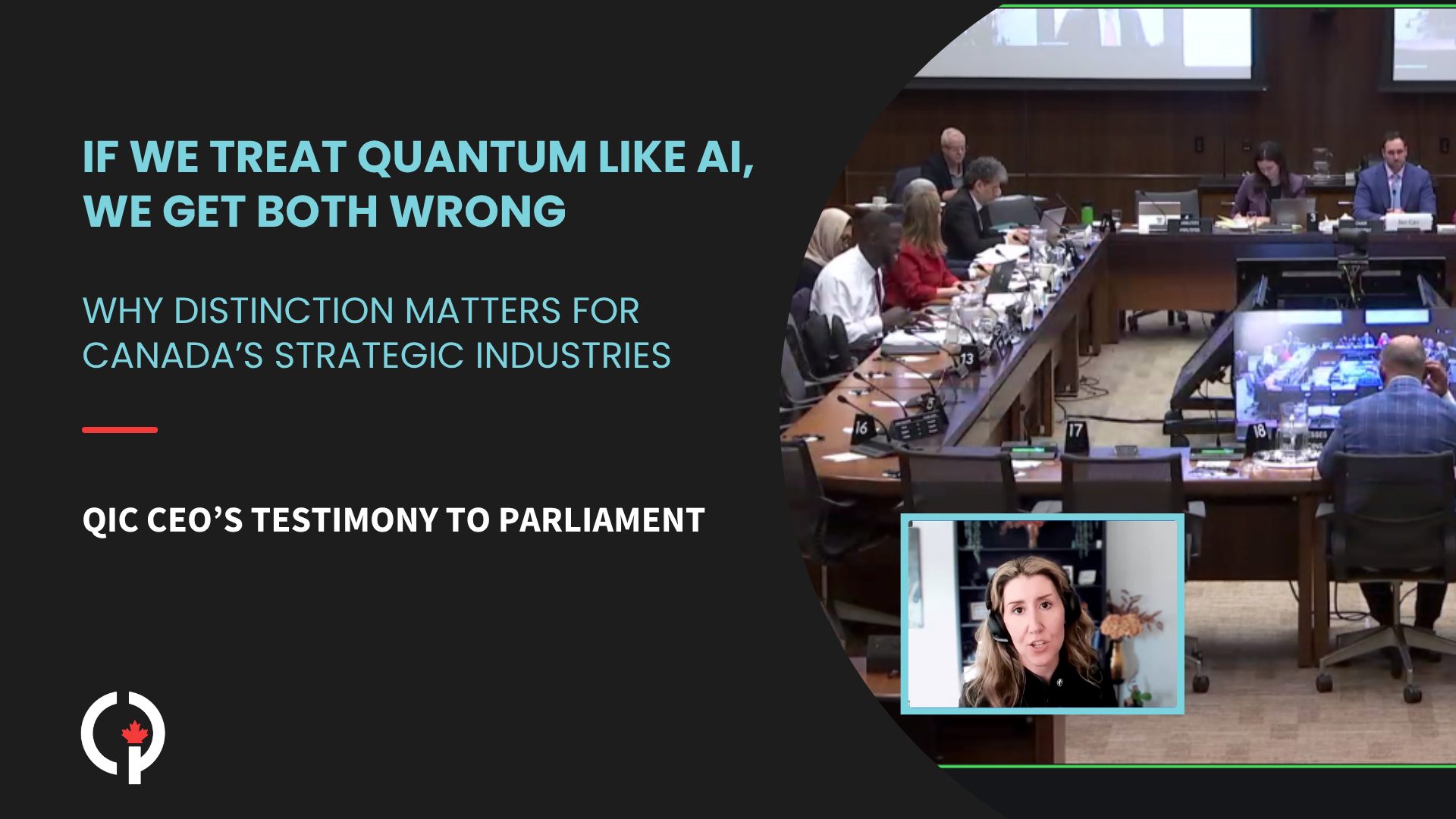
On April 30, 2026, Lisa Lambert, CEO of Quantum Industry Canada (QIC), appeared as a witness before the House of Commons Standing Committee on Industry and Technology (INDU) as part of its study on “Opportunities, Risks, and Regulation of AI in Canada’s Strategic Industries.”
Her opening statement underscores a central message: AI and quantum are distinct technologies with different capabilities, timelines, risks, and policy implications — and treating them as a single category creates real risk in both policy and execution.
The testimony also highlights the growing convergence of AI, high-performance computing, and quantum systems; the urgent need for coordinated execution on post-quantum cybersecurity; and the importance of ensuring Canada converts its early strengths in quantum into enduring strategic and economic advantage.
QIC CEO's Opening Statement to Parliament: If We Treat Quantum Like AI, We Get Both Wrong
“Chair and Members of the Committee, thank you for the invitation to appear today.
You’re studying artificial intelligence. Let me start by clarifying something that is often blurred in policy discussions: AI and quantum are distinct technologies, and grouping them as a single category creates real risk in both policy and execution.
AI is about learning from data — identifying patterns, making predictions, and automating decisions using today’s computing hardware.
Quantum is something categorically different. It’s a fundamentally different way of processing information on new hardware — making certain classes of problems approachable in entirely new ways, including problems that are effectively out of reach today.
Quantum also includes sensing and communications, enabling new ways to detect, navigate, and secure our world. But for this discussion, I’ll focus mainly on quantum computing.
If AI is about extracting insight from data, quantum computing is about expanding what is computationally possible.
These are distinct technologies with different capabilities, timelines, risks, and policy needs. If we group them together wholesale, we risk misjudging those risks, misapplying regulation, and missing the specific opportunities and vulnerabilities each presents.
They’re also complementary. AI is accelerating quantum development, and the future of compute is not replacement but convergence: AI, high-performance computing, and quantum working in concert. As AI scales, limits are emerging in energy, cost, and sheer compute. Quantum computing offers, over time, potential paths through some of those constraints.
Other countries are already making coordinated investments in this convergence. Canada has the ingredients to lead — strength in AI, a world-class quantum ecosystem, deep computing expertise — but today, we lack a fully integrated strategy that looks across these technologies, rather than treating them in isolation, and fully leverages our quantum strengths. That means integrating and scaling Canada’s quantum champions as a core part of our frontier compute strategy.
Now let me turn to an issue that cuts across everything you’re studying: cybersecurity.
Quantum and AI are advancing on converging timelines — already threatening the integrity of our systems.
AI is already changing the nature of cyberattacks.
At the same time, adversaries are harvesting encrypted data today — government communications, financial records, sensitive intellectual property — with the expectation of decrypting it once quantum computers mature. This is not a future threat. It’s a present one.
Canada has taken an important step. In June 2025, the Canadian Centre for Cyber Security released its roadmap for migration to post-quantum cryptography. Departmental migration plans were due this month — so effectively by end of day today. High-priority government systems must be completed by 2031.
The question now is execution, because this is not just a migration. It’s a generational opportunity to strengthen our cryptographic foundations, making them more agile and resilient against a rapidly evolving threat landscape.
The Cyber Centre’s roadmap covers federal IT infrastructure. But Canada’s economic and national security depends on a far broader ecosystem: critical infrastructure, financial systems, supply chains, and SMEs across them.
In an interconnected system, the weakest link defines the risk.
Government must now signal clearly and with urgency that this transition extends across the economy, not just federal departments. That means using procurement — already identified in the roadmap — to pull the market forward, extending expectations to critical infrastructure, and ensuring Canada is equipped to execute — not just set direction, but build the capacity and coordination to act.
If we get this right, we do more than mitigate a threat. We build a foundation of trust that underpins AI adoption, quantum deployment, economic resilience, and national security. Many Canadian firms are leaders in developing the quantum-safe solutions required. This is both a security imperative and a commercial opportunity.
Three points to leave you with.
First, AI and quantum are distinct technologies and must be treated as such in policy and regulation, while recognizing their evolving convergence.
Second, the future of compute lies in the convergence of AI and quantum, and Canada has the ingredients to lead — if we move at pace to scale our quantum strengths, so early leadership translates into enduring advantage.
Third, on cybersecurity, federal plans were due this month. The window for preparation is now. What this committee can do is ensure that execution and accountability follow — across government, and across the economy.
Thank you. I welcome your questions.”